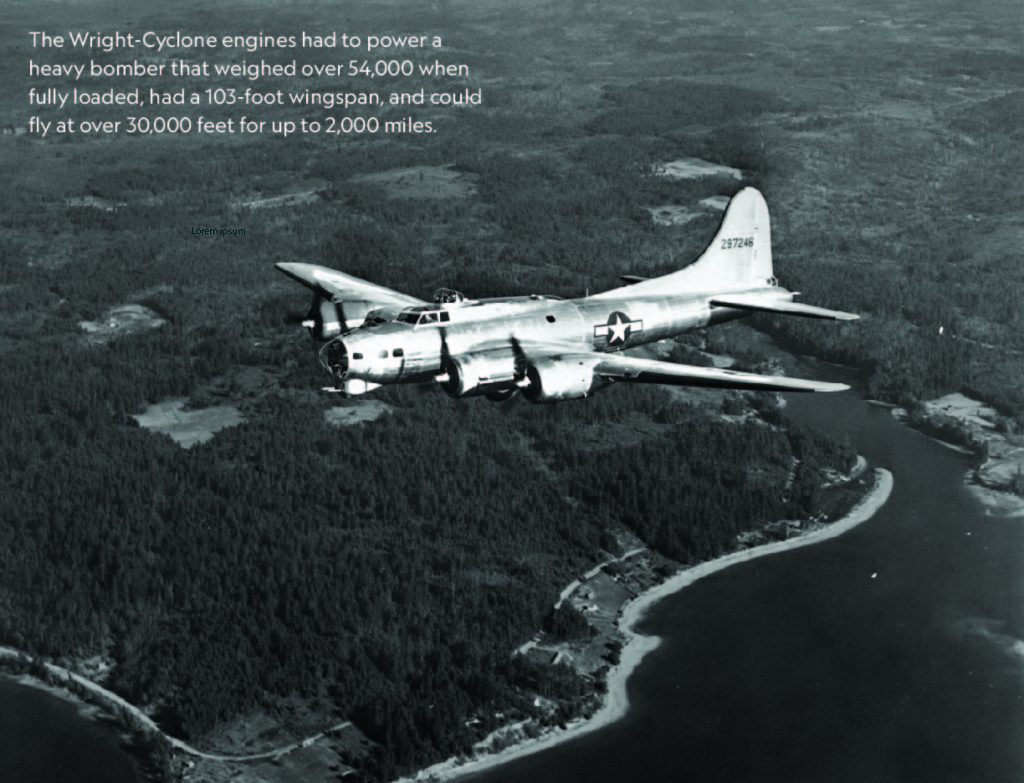
Powering Masters of the Air: Studebaker & the B17 Flying Fortress
Each B17 Flying Fortress was powered by four Wright-Cyclone R1820 radial engines.
Studebaker built over 60,000 R1820 engines at the new Chippewa Avenue plant in South Bend supplemented by additional factories in Fort Wayne and Chicago. While the basic engine assembly processes was similar to those for automobile engines, the R1820 was far more complex and required the utmost in precision and exacting tolerances. Each R1820 had over 8,000 individual parts, compared to a couple hundred for a contemporary Studebaker passenger car engine.
Upon completion, each engine was installed in a large two-story concrete test cell where it underwent a “green test.” This involved running the engine for four hours over a normal range of speeds and loads, including 5-minute full-throttle runs to simulate take-off or top speed. It was then completely torn down and inspected before being certified for final assembly and a final test run.
After final assembly, engines were shipped to Studebaker’s Pacific Plant in Vernon, California for distribution to B17 production facilities Boeing, Douglas, and Lockheed subsidiary Vega.
This information comes from our former exhibition Powering Masters of the Air.